Cart
2026 Top Stainless Mesh Types for Global Buyers
In 2026, global buyers will face a wider choice of stainless mesh products, finishes, and manufacturing methods. Woven wire mesh remains common for filtration, screening, and separation. Welded mesh suits panels, guards, and structural applications. Expanded metal offers a different balance between airflow, weight, and strength. Each type performs differently under pressure, heat, moisture, and repeated cleaning.
Details matter. Wire diameter, opening size, alloy grade, surface finish, and edge treatment can change the final result. Stainless mesh made from 304 steel often supports general industrial use. Grade 316 may provide better resistance in marine or chloride-rich environments. However, material selection should follow actual exposure conditions, not simple assumptions. A polished surface may improve cleanliness, but it does not automatically solve every corrosion risk.
Experienced buyers usually review drawings, sample pieces, inspection records, and test certificates before placing large orders. Product descriptions alone can hide tolerance differences. A mesh opening measured before welding may not match the finished panel. That detail can affect filtration accuracy or installation fit. Fit changes everything.
This guide compares leading stainless mesh types for international purchasing teams in 2026. It considers performance, customization, packaging, documentation, and supplier communication. Recognized standards can improve consistency, but requirements vary by market and application. Buyers should confirm the relevant specifications with qualified engineers and suppliers. No guide replaces practical testing. Some decisions remain imperfect, especially when cost, delivery speed, and service life compete. Careful verification still reduces avoidable risk and supports more reliable sourcing.
Classify Mesh by Count, Wire Diameter, Aperture, and Open Area
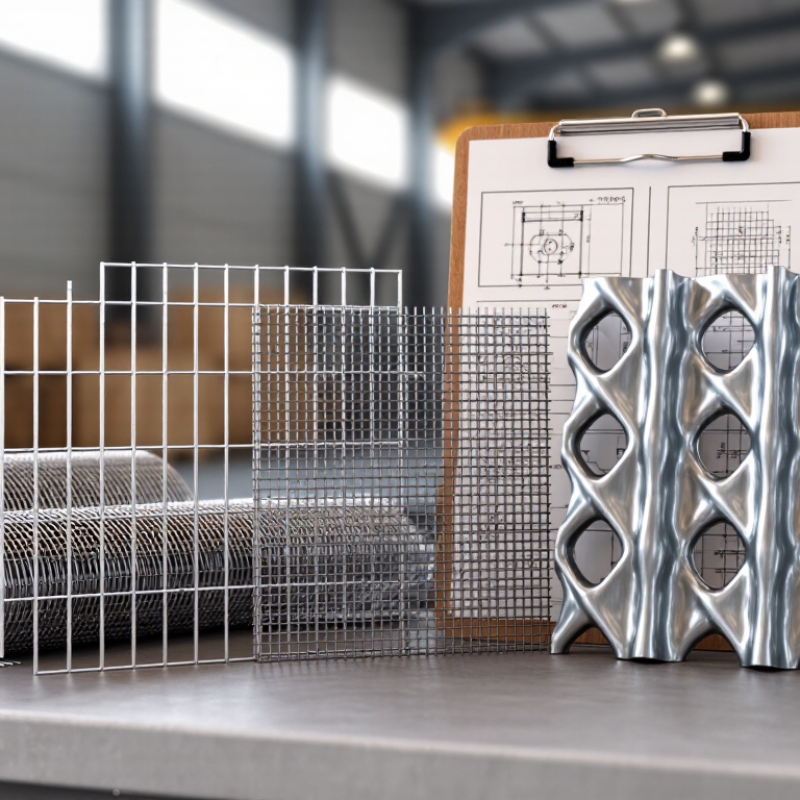
Stainless mesh should be classified by four linked measurements: mesh count, wire diameter, aperture, and open area.
The International Stainless Steel Forum reported global stainless steel production above 60 million tonnes in 2024. That scale supports broad material availability, but it does not guarantee identical mesh performance.
Mesh count means openings per linear inch. Wire diameter controls strength, weight, and filtration resistance.
Aperture can be estimated as: 25.4 ÷ mesh count − wire diameter , with values in millimeters.
For example, 100 mesh using 0.10 mm wire gives an aperture near 0.154 mm.
Its theoretical open area is about 36.8 percent. Open area follows this formula:
Small changes matter.
ASTM E11-24 defines requirements for woven wire test sieve cloth, including opening tolerances and inspection methods. Buyers should compare measured aperture, not only the advertised mesh count.
A heavier 100-mesh wire can reduce open area sharply, while a thinner wire may improve flow but reduce handling strength. ISO-style metric specifications can also prevent inch-to-millimeter misunderstandings.
One weakness remains: calculated values assume uniform weaving. Real rolls may show tension variation, edge distortion, or local aperture differences. Requesting a sample and inspection report is wiser than trusting one catalog line.
Compare 304 and 316L Using 18% Cr, 8% Ni, and 2–3% Mo Benchmarks
Global buyers often compare stainless mesh by alloy chemistry before examining weave, wire diameter, or opening size. That is sensible, but incomplete. In practical inspection, a mesh can meet the nominal grade and still fail a demanding application because of poor welding, contamination, or incorrect surface treatment.
Type 304 is commonly assessed around 18% chromium and 8% nickel. This balance supports useful corrosion resistance, clean forming, and competitive cost. It suits many dry, indoor, and mildly humid environments.
Type 316L adds roughly 2–3% molybdenum, while nickel commonly rises toward 10–14%. The chromium range is usually about 16–18%.
Molybdenum improves resistance to chloride attack, which matters near seawater, salt spray, and chemical washdown areas. The “L” also indicates low carbon, typically no more than 0.03%, helping reduce sensitization after welding.
Do not treat these numbers as a purchasing shortcut.
Request a material test certificate and check the heat number against the shipment. A handheld analyzer may help screen incoming rolls, but it cannot replace laboratory verification. Mesh openings deserve equal attention; a small dimensional error can affect filtration performance. I have found the chemistry table reassuring, yet the finished mesh still needed closer review. Corrosion behavior depends on exposure, cleaning, crevices, and fabrication quality. That part is easy to underestimate.
Choose Woven, Welded, Knitted, or Expanded Mesh by Load and Aperture
2026 Top Stainless Mesh Types for Global Buyers
Choosing stainless mesh starts with load and aperture, not appearance. Woven mesh offers accurate openings for filtration, screening, and controlled particle separation. Fine wire creates smaller apertures, but it may deform under impact or repeated pressure. Heavy woven grades provide better support, although they can reduce flow and increase cleaning effort.
Welded mesh suits panels, guards, racks, and enclosures that need firm geometry. Its welded joints resist shifting when the mesh carries a steady load. Select thicker wire and tighter spacing for stronger barriers. However, welded intersections can become stress points during bending. A supplier should verify weld quality, wire diameter, aperture tolerance, and corrosion resistance.
Knitted mesh behaves differently. Its flexible loops absorb vibration and support sealing, noise control, and mist separation. It works well around irregular surfaces. Expanded mesh uses slits and stretched strands, creating a rigid, lightweight sheet with useful airflow. It can support walkways, screens, and protective covers, depending on strand size and open area.
I have seen projects specify aperture only, then struggle with deflection later. That mistake is easy to repeat. Real installations are less tidy than drawings. Check span, edge fixing, temperature, cleaning pressure, and expected impact before ordering. I would also request a sample, because nominal aperture can feel very different in hand. A small trial often reveals handling problems, sharp edges, or insufficient rigidity before full production.
2026 Top Stainless Mesh Types for Global Buyers
Choose woven, welded, knitted, or expanded mesh by required aperture and structural section.
How to read the chart: Values show representative midpoint dimensions from commonly specified stainless-steel mesh ranges. Larger section or strand dimensions generally support higher loads, while smaller apertures provide finer screening. Actual load capacity depends on alloy, temper, span, fixing method, panel size, and applied load, so structural calculations are required for safety-critical projects.
Match Filtration Grades with ISO 9044 and ASTM E2016 Requirements
2026 Top Stainless Mesh Types for Global Buyers
Stainless steel mesh is available in plain weave, twill weave, and Dutch weave forms. Each structure supports different filtration demands. Plain weave offers clear openings and simple inspection. Twill weave handles finer openings with stronger wire support. Dutch weave favors pressure filtration and controlled particle retention. Opening size matters.
ISO 9044 helps buyers define industrial woven wire cloth through mesh count, wire diameter, aperture, material, and testing requirements. ASTM E2016 provides related terminology and specification guidance for woven wire cloth. These standards do not replace process testing. They help make purchase documents more precise. A stated “100 mesh” value is incomplete without wire diameter and nominal aperture.
Ask suppliers for aperture measurements, dimensional tolerances, material details, and inspection records. Compare the reported opening with the required filtration grade, not only the mesh count. For a laboratory screen, microscopic aperture checks may be appropriate. For a production filter, pressure, flow rate, and cleaning cycles also affect selection. Do not guess.
A practical specification might state stainless material, weave type, nominal aperture, wire diameter, and applicable ISO 9044 and ASTM E2016 references. Samples should be checked before volume purchasing. Tolerances can influence separation performance. This point is often underestimated. A perfect paper match may still perform poorly in a real slurry, gas stream, or heated process. Supplier documents can be clear, yet field conditions remain less predictable.
Verify Global Orders Against ASTM A580 Chemistry, Testing, and Traceability
Global stainless mesh buying is growing with wider industrial demand. The International Stainless Steel Forum reported about 58.4 million tonnes of crude stainless steel production in 2023. That volume creates more sourcing options, but also more paperwork risk.
For international orders, match the mesh wire to ASTM A580/A580M requirements. Check the stated grade, heat number, wire diameter, tensile results, and chemical composition. Chemistry should identify key elements such as chromium, nickel, molybdenum, carbon, and nitrogen. Limits depend on the specified grade. Do not accept a generic “stainless steel” description. Ask for an inspection report linked to the actual production lot. ASTM A751 provides recognized guidance for chemical analysis and sampling of steel products. Testing must remain traceable from sample preparation to laboratory result.
Keep it practical.
Compare the certificate, packing list, coil labels, and mesh inspection records line by line. A heat number should not disappear when wire becomes woven mesh. Independent testing can confirm chemistry, but it cannot repair weak chain-of-custody records. The World Steel Association’s Steel Statistical Yearbook shows how large and complex global steel supply has become, making document discipline essential. A photocopied certificate may look convincing. It may still describe another heat. Buyers should record deviations, question unclear results, and review whether the chosen test frequency fits the order’s risk. Perfect paperwork is not proof, but missing links are a clear warning.
| Mesh Type | Typical Stainless Grades | Typical Construction or Use | Typical Specified Chemistry, wt.% | Key Buyer Verification Points | Recommended Documentation |
|---|---|---|---|---|---|
| Plain-Woven Wire Mesh | 304 / 304L | Balanced strength, open area, and corrosion resistance; commonly used for screening, filtration, guards, and general industrial separation. |
304: C ≤ 0.08, Cr 18.0–20.0, Ni 8.0–10.5 304L: C ≤ 0.03, Cr 18.0–20.0, Ni 8.0–12.0 |
Confirm wire diameter, mesh count, aperture tolerance, weave integrity, edge condition, and grade marking against the purchase specification. | Heat/lot number, material test report, chemistry results, dimensional inspection record, and certificate of conformity. |
| Plain-Woven Wire Mesh | 316 / 316L | Higher resistance to chlorides and many chemical environments; suitable for marine, pharmaceutical, food-processing, and chemical applications. |
316: C ≤ 0.08, Cr 16.0–18.0, Ni 10.0–14.0, Mo 2.0–3.0 316L: C ≤ 0.03, Cr 16.0–18.0, Ni 10.0–14.0, Mo 2.0–3.0 |
Check molybdenum content, low-carbon designation where welding is involved, aperture uniformity, and resistance to corrosion relevant to the service environment. | Heat-specific chemistry report, mechanical test results where specified, dimensional report, surface inspection, and traceability statement. |
| Twill-Woven Wire Mesh | 304 / 316 / 316L | Higher wire density and strength than comparable plain weave; used for finer filtration and applications requiring increased load capacity. | Chemistry must match the selected grade and the applicable ASTM or material specification; typical 316L limits include C ≤ 0.03, Cr 16.0–18.0, Ni 10.0–14.0, Mo 2.0–3.0. | Verify actual aperture, wire diameter, mesh count, weave pattern, filtration rating, flatness, and freedom from broken or displaced wires. | Material test report, mesh analysis or aperture report, lot identification, inspection photographs where required, and packing list traceability. |
| Dutch-Woven Filter Mesh | 304 / 316 / 316L | Fine filtration with high retention capability; commonly supplied as plain Dutch or twill Dutch construction for pressure and process filtration. | Grade-specific chemistry applies. For 304L: C ≤ 0.03, Cr 18.0–20.0, Ni 8.0–12.0. For 316L: C ≤ 0.03, Cr 16.0–18.0, Ni 10.0–14.0, Mo 2.0–3.0. | Define filtration rating, micron retention, warp and shute wire sizes, flow direction, permeability requirement, and pressure-service condition. | Heat certificate, chemistry verification, filtration or bubble-point test where specified, dimensional inspection, and lot-level identification. |
| Welded Wire Mesh | 304 / 304L / 316 / 316L | Rigid panels or rolls for machine guards, partitions, baskets, racks, architectural panels, and industrial enclosures. | Chemistry must be verified by heat number. Typical 304L limits: C ≤ 0.03, Cr 18.0–20.0, Ni 8.0–12.0. Typical 316L limits: C ≤ 0.03, Cr 16.0–18.0, Ni 10.0–14.0, Mo 2.0–3.0. | Inspect weld quality, weld spacing, panel squareness, wire diameter, opening size, cut edges, distortion, and resistance to handling damage. | Heat/lot traceability, welding or production inspection record, dimensional report, surface-finish statement, and certificate of conformity. |
| Crimped or Square-Opening Mesh | 304 / 316 / 316L | Pre-crimped construction for screening, sizing, quarrying, aggregate separation, and heavier-duty applications. | Use the chemistry limits for the ordered grade. A typical 304 composition is C ≤ 0.08, Cr 18.0–20.0, Ni 8.0–10.5; a typical 316 composition is C ≤ 0.08, Cr 16.0–18.0, Ni 10.0–14.0, Mo 2.0–3.0. | Confirm opening shape, pitch, wire diameter, crimp type, tolerance, panel dimensions, load requirements, and visible cracking at crimp points. | Material test report, dimensional inspection, lot number, visual inspection record, and packaging identification linked to the shipment. |
| High-Temperature Stainless Mesh | 321 / 310S | Used for elevated-temperature service, furnace components, heat-treatment fixtures, and thermal processing equipment. |
321: C ≤ 0.08, Cr 17.0–19.0, Ni 9.0–12.0, Ti ≥ 5 × C and ≤ 0.70 310S: C ≤ 0.08, Cr 24.0–26.0, Ni 19.0–22.0 |
Verify grade selection for operating temperature, oxidation environment, wire diameter, creep or distortion risk, and heat-treatment condition where specified. | Heat-specific chemistry report, applicable mechanical test results, high-temperature service declaration, dimensional report, and traceability records. |
| Ferritic Stainless Mesh | 430 | Moderate corrosion resistance and good oxidation resistance for screens, decorative panels, appliance components, and indoor industrial uses. | C ≤ 0.12, Cr 16.0–18.0, Ni typically not intentionally added; confirm the complete chemistry against the ordered specification. | Check magnetic response expectations, surface condition, forming requirements, wire diameter, aperture accuracy, and resistance to the intended atmosphere. | Heat certificate, complete chemistry report, dimensional inspection, surface-finish report, and product identification record. |
Related Posts
-
10 Best Stainless Mesh Suppliers for Global Buyers?
-
What is Stainless Steel Mesh and Its Applications in Industry?
-
Top 10 Tips for Choosing the Right Stainless Steel Mesh for Your Needs
-
What is Wire Mesh Panels and How Are They Used in Various Industries
-

Top 10 Benefits of Wire Mesh Screens for Home and Industrial Use
-
Top Benefits of Using PVC Coated Wire Mesh for Your Projects