
Specialty Metal & Fiberglass Products
ISO 9001:2015 Certified
Cart
What Is the Best Multi Hole Drilling Machine in 2026?
Choosing the best Multi Hole Drilling Machine in 2026 is less about finding the biggest motor than matching equipment to real production needs. A small cabinet shop may value quick setup and accurate hole spacing. A door manufacturer may need repeatable patterns across long shifts. The right choice depends on materials, panel dimensions, hole diameters, spindle layout, and expected daily volume. That matters.
This guide compares the practical features buyers should examine, including drilling capacity, adjustable stops, changeover time, safety guards, and service access. It also considers how well a machine handles common tasks, from shelf-pin rows to hinge-cup preparation. A specification sheet can look impressive, yet it rarely shows how smoothly an operator can load a heavy panel or clear chips between cycles. Ask for a demonstration using material similar to your own.
There is no universal winner—and that is easy to forget when comparing brochures. A high-speed machine may be a poor fit if its setup takes too long or its support is difficult to reach. Buyers should check accuracy, parts availability, training, and total operating costs alongside purchase price. Small differences add up. The recommendations ahead aim to separate useful capability from marketing language, while recognizing that shop conditions vary. Even careful research cannot replace a real trial; that is one limitation worth keeping in view. The best machine is the one that meets your production targets reliably, fits your workspace, and remains practical for the people who use it every day.
What Is a Multi-Hole Drilling Machine?
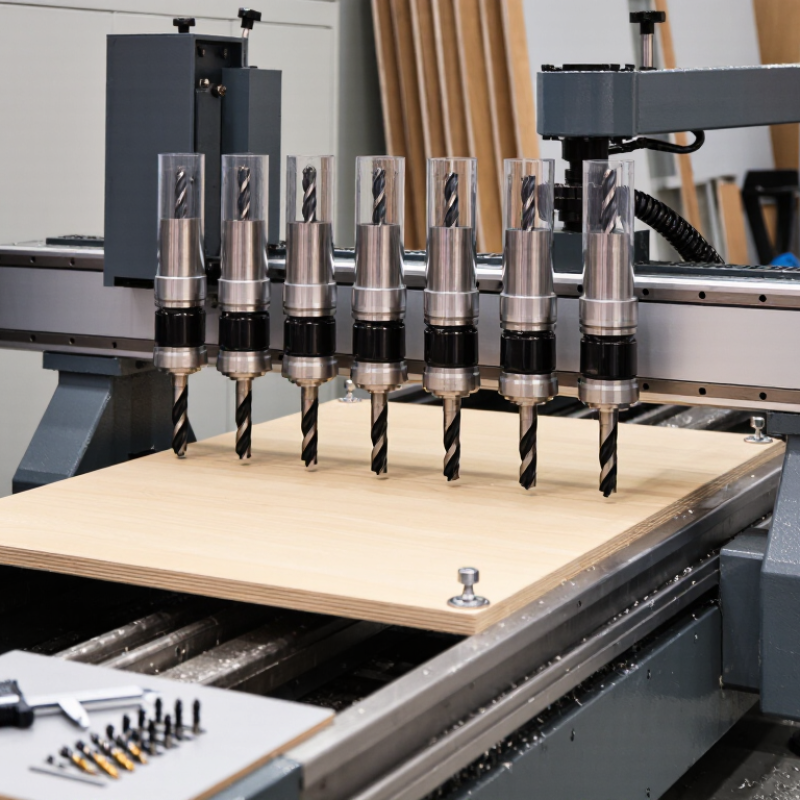
A multi-hole drilling machine is a production tool designed to make several holes in one workpiece during a single cycle. It may use multiple spindles, a drilling head, or indexed positioning, depending on the required hole pattern. Some machines drill every hole at once; others move the workpiece between positions. The distinction matters.
With fixed spindle spacing, the machine suits repeated layouts in panels, plates, furniture parts, and metal components. A fixture holds the material steady, while depth stops help keep holes consistent. Operators still need to check bit condition, clamping pressure, and chip removal. Small setup errors can shift an entire row. That is frustrating.
A multi-hole unit can improve throughput, but it is not automatically the best choice for every shop. Consider hole diameter, material, spacing tolerance, daily output, and changeover time. A dedicated machine may suit one recurring pattern, while an adjustable or CNC-controlled model handles varied work more flexibly. Ask for a sample run using your actual material. Watch the edges, depth, and spacing—not just the cycle speed. Even a good specification sheet leaves questions unanswered.
| Machine Type | How It Works | Best Suited For | Key Advantages | Important Considerations | Overall Fit |
|---|---|---|---|---|---|
| Fixed multi-spindle drill | Multiple spindles drill several holes at once, typically in a fixed pattern. | Repeat production of parts with the same hole layout. | Can reduce cycle time and keep hole spacing consistent when the workpiece and setup are controlled. | Changing hole patterns may require spindle or tooling adjustments; fixture quality is important. | Best for stable, high-volume jobs. |
| CNC multi-spindle drilling machine | Computer-controlled axes position the workpiece, tooling, or drilling heads according to a programmed operation. | Production with multiple hole patterns, repeatable positioning, or frequent program changes. | Offers programmable operation and can reduce manual repositioning for suitable parts. | Requires programming, operator training, and a suitable workholding and maintenance plan. | A strong choice when flexibility and repeatability both matter. |
| Gang drilling machine | Several drilling heads are arranged in a row so a part can move between stations for successive operations. | Parts needing a sequence of drilling, countersinking, or related operations. | Allows multiple operations to be set up at separate stations and can limit tool changes at one station. | Uses more floor space than a single-head setup and is most effective with a consistent process sequence. | Best for repeatable, sequential shop-floor operations. |
| Radial drilling machine | A movable drill head travels along a radial arm to reach different positions on a large workpiece. | Large or heavy parts with holes in several locations. | Can reach different areas without moving a large workpiece as often as a fixed-position drill may require. | Holes are generally drilled in sequence rather than simultaneously; positioning and setup affect accuracy. | Best for large workpieces and lower-volume work. |
| Automated drilling line or cell | Integrated drilling stations, workholding, and material handling perform a defined production process. | High-volume production with consistent parts and a well-defined workflow. | Can coordinate drilling with part transfer and other production steps. | Requires a larger investment, process planning, and space; changes to the product or layout may be complex. | Best when production volume justifies automation. |
What is a multi-hole drilling machine? It is a drilling machine or system designed to produce multiple holes in a workpiece, either simultaneously or through a coordinated sequence of operations. The best choice depends on the hole pattern, part size and material, production volume, required accuracy, changeover frequency, and available budget.