
Cart
What Is the Best Type of Plastic Extruder in 2026?
Choosing the best Plastic Extruder in 2026 depends on more than its advertised output. Material, product design, and production schedule matter just as much. A single-screw machine often suits steady processing of familiar thermoplastics. Twin-screw designs provide stronger mixing and greater flexibility for additives, fillers, or recycled feedstock. There is no universal winner. A poor match can cause uneven melt, excess scrap, and frequent adjustments.
This guide compares extruder types using practical factors: screw configuration, throughput, temperature control, energy use, maintenance access, and compatibility with downstream equipment. A line making pipe from clean pellets may need different features from one processing variable regrind. Small details matter. Stable melt temperature, an accessible screen changer, and a well-matched haul-off can all affect product quality. Buyers should also consider changeover frequency, operator training, spare-parts availability, and planned downtime. Specifications help, but they cannot replace a material trial under realistic operating conditions. That is easy to forget. Published output rates may depend on resin grade, tooling, and settings, so treat them as estimates, not guarantees. The sections ahead explain each design’s strengths, limitations, and suitable applications. They also offer questions to ask suppliers before investing. The best choice is the machine your team can operate reliably, not simply the one with the strongest brochure claims.
What a Plastic Extruder Does and How It Works
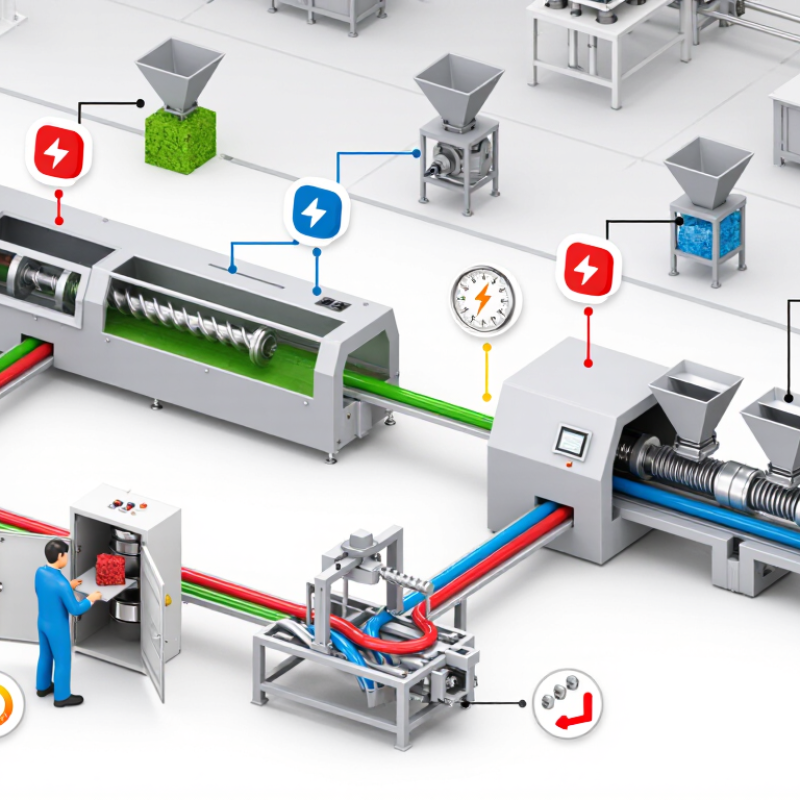
A plastic extruder turns solid resin pellets into a continuous, shaped product. Pellets fall from a hopper into a heated barrel, where a rotating screw moves, compresses, and melts them. Friction matters too. Heaters alone do not do the work. Sensors track melt temperature and pressure as the material reaches a die, which shapes it into film, pipe, or a narrow profile. Downstream rollers or a cooling bath set the shape; a cutter or winder then handles the finished length.
PlasticsEurope’s Plastics—the Fast Facts 2024 report puts global plastics production at 413.8 million tonnes in 2023. That figure covers many processes, not extrusion alone, but it shows the scale of material processing. For a straightforward product, a single-screw machine may be a practical choice. Twin-screw designs can offer more intensive mixing for blended or filled materials. The right setup depends on resin, output, and product tolerances—not on screw count alone. In operation, small changes in moisture, temperature, or screw speed can leave visible defects, such as rough surfaces or uneven dimensions. Real lines are less tidy than diagrams. Regular checks of the melt and finished product matter as much as the machine specification.
The Main Types of Plastic Extruders in 2026
What Is the Best Type of Plastic Extruder in 2026?
The Main Types of Plastic Extruders in 2026
A single-screw extruder is widely used for steady production of pipes, sheets, and film. Its rotating screw pushes and melts pellets inside a heated barrel. Operators value its relatively simple setup. But changing materials can require careful cleaning and process adjustments.
Twin-screw extruders use two screws that may rotate together or in opposite directions. They can offer strong mixing and precise control, useful when recipes include several ingredients or need thorough dispersion. That extra control comes with more complex equipment and maintenance.
Ram extruders work differently: a piston pushes material through a die. They suit certain high-viscosity materials, though their production may be less continuous. Specialized multi-screw designs also serve particular mixing or processing needs.
There is no universal winner. Match the machine to the resin, target output, melt temperature, and required consistency. Check actual production data, not just a supplier’s maximum-throughput figure.
A neat comparison table can still hide troublesome details, such as uneven feeding or frequent cleaning. I would treat any “best” ranking as a starting point, not a verdict. A short material trial can reveal more than a polished specification sheet.
How Extruder Designs Differ in Materials and Output
The best plastic extruder in 2026 is not automatically the machine with the highest rated output. It is the design that handles a specific polymer steadily, with acceptable energy use and manageable changeovers. A single-screw extruder is often a practical choice for uniform pellets and straightforward profiles. Its rotating screw conveys, melts, and pressurizes material along one continuous path. Simple can be an advantage.
Twin-screw designs provide stronger mixing and more control over blends, additives, or materials with uneven feeding behavior. Intermeshing screws can disperse color and fillers more consistently, though setup and maintenance are more demanding. For heat-sensitive polymers, screw geometry, barrel temperature, and residence time matter as much as the machine category. Watch the melt, not just the control screen.
Ram extruders suit some high-viscosity compounds and specialized small runs, but their output is typically intermittent rather than continuous. Moisture, particle size, and feed consistency can change results; damp feed may cause bubbles or a rough surface. Compare output by stable kilograms per hour, not peak claims. There is no perfect setup. Even experienced operators may adjust settings when a material lot changes. A short production trial often reveals more than a specification sheet.
What Is the Best Type of Plastic Extruder in 2026? — How Extruder Designs Differ in Materials and Output
| Extruder Design | How It Works | Common Materials | Typical Applications | Indicative Output Range | Best Suited For | Key Consideration |
|---|---|---|---|---|---|---|
| Single-screw extruder | One rotating screw conveys, melts, and pressurizes material through a heated barrel. | Polyethylene (PE), polypropylene (PP), polystyrene (PS), and many PVC formulations. | Pipe, profiles, film, sheet, pelletizing, and general-purpose extrusion. | About 20–1,000 kg/h, depending on screw diameter, material, and product. | Continuous production of a consistent, well-prepared feedstock. | Usually economical and straightforward, but less effective than twin-screw designs for intensive mixing or highly variable feed. |
| Co-rotating twin-screw extruder | Two intermeshing screws rotate in the same direction, supporting strong conveying and distributive and dispersive mixing. | Engineering plastics, filled or reinforced polymers, color concentrates, and polymer blends. | Compounding, masterbatch production, devolatilization, and reactive processing. | About 10–1,500 kg/h; smaller machines are often used for specialty formulations. | Formulations that need controlled mixing, additive dispersion, or frequent recipe changes. | Offers process flexibility, but typically requires a higher equipment investment and more process expertise than a basic single-screw line. |
| Counter-rotating twin-screw extruder | Two screws rotate in opposite directions; intermeshing designs provide positive conveying and relatively controlled melt handling. | Rigid and flexible PVC compounds, including heat-sensitive formulations. | PVC pipe, window profiles, siding, and other PVC profiles. | About 30–1,000 kg/h, depending on machine size, formulation, and product. | PVC processing where steady conveying and careful temperature management are important. | Screw and barrel configuration is usually tailored to the PVC formulation and intended product. |
| Ram (plunger) extruder | A reciprocating ram pushes softened or prepared material through a die rather than using a continuously rotating screw. | Selected high-viscosity, heat-sensitive, or difficult-to-convey materials; use is specialized. | Specialty profiles, laboratory work, and processes where screw shear or continuous screw conveying is unsuitable. | Often about 5–100 kg/h; highly dependent on the material and operating cycle. | Low-volume or specialized processing where material behavior favors ram-driven flow. | Generally less suited to high-throughput continuous production than screw extruders. |
Note: Output ranges are indicative, not guaranteed ratings. Actual throughput depends on extruder size and configuration, polymer grade, additives, moisture, screw speed, die design, and product requirements. The best choice is the design that meets the material and quality requirements at the required production rate.
Which Extruder Type Suits Each Production Need
What Is the Best Type of Plastic Extruder in 2026?
Which Extruder Type Suits Each Production Need
A single-screw extruder often suits steady production of familiar materials, such as pipe, sheet, or film. Its straightforward design can make operation and maintenance easier. For a line running one resin at a consistent rate, that simplicity matters. Watch the melt temperature and screw speed; uneven heating can affect product dimensions.
Twin-screw machines fit jobs needing stronger mixing, such as blending polymers with colorants or reinforcing fillers. Their screws can move and mix material more actively, but setup is more involved. They may also require closer attention to energy use and wear. Small batches? A lab-scale twin-screw unit can help teams test formulations before committing to a larger line.
Ram extruders are worth considering for some highly viscous materials or specialized, lower-volume profiles. They do not suit every continuous production task, so confirm the required output and cycle time first. There is no perfect machine. I would compare material behavior, target throughput, cleaning time, and operator experience before choosing. It is easy to focus on maximum output and overlook changeovers. That can be a costly mistake. A practical trial with the actual material can reveal issues that a specification sheet misses.
Key Factors for Choosing the Best Extruder in 2026
Choosing the best plastic extruder in 2026 starts with the material and product, not a headline capacity figure. A line making thin film has different needs from one producing rigid profiles or pellets. Check the resin’s melt behavior, required output, and acceptable variation in dimensions. Small inconsistencies matter. A profile that looks fine at startup may drift after hours of production.
Match the screw design and barrel configuration to the material’s flow, including any fillers or additives. Compare usable throughput, melt temperature stability, and screen-change arrangements. Ask for performance data under your actual operating conditions; catalog figures alone can be optimistic. Controls should make adjustments clear to operators, not bury them in menus. Also inspect access to heaters, drives, and screw components. Routine maintenance affects uptime and safety.
Measure energy use across a full shift, alongside scrap rates and changeover time. Consider floor space, ventilation, service availability, and possible product changes before selecting a machine. A smaller extruder may be the better fit if it runs steadily; excess capacity can add cost without improving quality. Estimates can still miss things. Test real material before committing, since a trial may reveal assumptions that looked reasonable on paper.
What Is the Best Type of Plastic Extruder in 2026?
Key factors for choosing the best extruder depend on the material and process—not on one universally superior machine.
A value of 1 indicates an application commonly associated with that extruder type; 0 means it is not included as a typical match here, not that the machine cannot perform it. This is a qualitative application map, not a measured performance ranking. Consider resin, output, product design, mixing needs, and budget before selecting equipment.
