
Specialty Metal & Fiberglass Products
ISO 9001:2015 Certified
Cart
How to Choose the Best Pipe Ring Bending Machine from China?
Choosing the right Pipe Ring Bending Machine from China requires more than comparing prices, motor power, or glossy factory photographs. The machine must match your pipe diameter, wall thickness, bending radius, material grade, and expected production volume. A stainless-steel ring for a handrail behaves differently from a thick carbon-steel frame. Small differences matter.
Industry data supports careful supplier evaluation. The China Machine Tool Industry Association reported continued pressure for higher automation and production efficiency across China’s manufacturing sector in 2024. Gardner Intelligence’s World Machine Tool Survey also continues to identify China as a major global producer and consumer of machine tools. These figures show manufacturing scale, not automatic quality. That distinction is easy to miss.
Tube-forming specialist Dr. Roland D. Hudson states, “A reliable bend is measured by repeatability, not by the first successful sample.” This principle should guide every quotation. Ask for test-bending videos, dimensional inspection records, tooling drawings, control-system details, and references from comparable factories. Request evidence for ovality, springback, surface marking, and angle tolerance. The best supplier should explain failure limits honestly.
Reports from MarketsandMarkets and Research and Markets indicate continued demand for automated metal-forming equipment, especially where labor costs and consistency influence purchasing decisions. Still, automation can hide poor setup knowledge. I would not choose the cheapest Pipe Ring Bending Machine without checking spare-parts availability, commissioning support, electrical compatibility, and operator training. A factory visit helps, but it is not proof by itself. Sometimes the uncomfortable answer is simple: the machine is sound, yet the tooling is wrong.
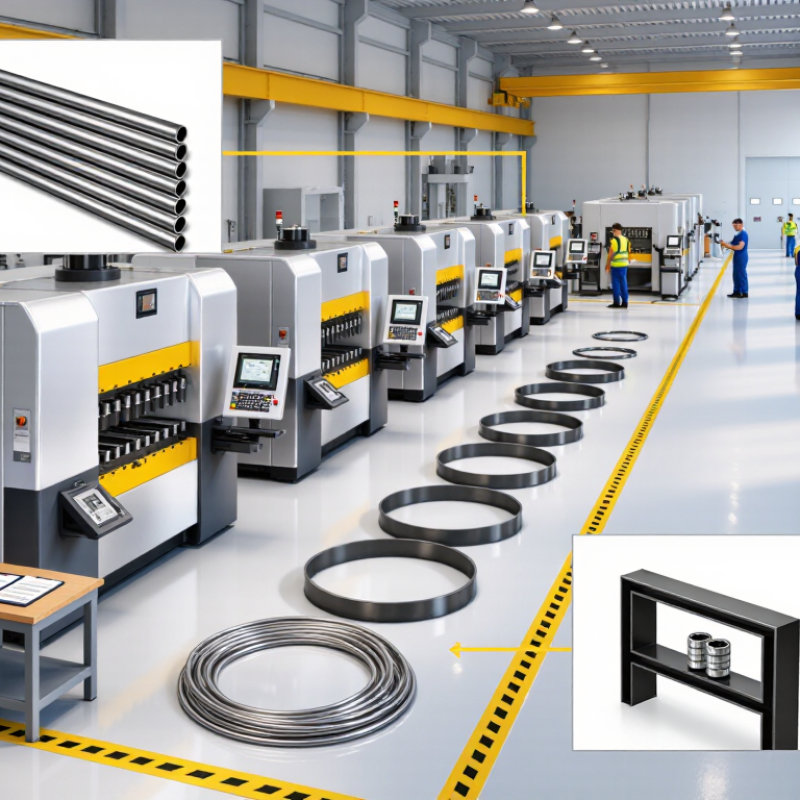
Define Your Pipe Ring Bending Requirements
How to Choose the Best Pipe Ring Bending Machine from China?
Define Your Pipe Ring Bending Requirements
Before contacting a Chinese manufacturer, describe the ring you need to produce. Record pipe material, outside diameter, wall thickness, and target ring diameter. Include tolerances, joint condition, and monthly quantity. A stainless steel tube with a 2 mm wall behaves differently from mild steel. I learned this after testing a machine with the correct diameter range but insufficient forming force. The sample looked acceptable, yet its roundness failed inspection. Do not rely on a catalog range alone. Ask for verified test data using your material and tooling.
Tips: Prepare a one-page requirement sheet. Add a drawing with dimensions, bend direction, and allowable ovality. State whether the ring needs one continuous bend or several indexed bends. Request videos, sample measurements, and a written tooling list. Confirm electrical specifications, spare parts, training, and remote support. Ask how operators adjust pressure and prevent surface marks. Small details matter. I once overlooked floor space and maintenance access. Installation became awkward. That mistake still influences my purchasing checklist.
When comparing machines from China, match capability to production risk, not just price. A reliable supplier should explain force calculations, control accuracy, tooling life, and quality checks. Check whether the machine can repeat the required radius across a full shift. Define acceptance criteria, such as a ±1 mm diameter tolerance and maximum ovality. If requirements remain vague, request a paid trial with your actual pipes. It may cost more initially. It can reveal weaknesses early. Keep communication records and confirm every technical change in writing.
How to Choose the Best Pipe Ring Bending Machine from China? - Define Your Pipe Ring Bending Requirements
| Requirement Dimension | Basic Requirement | Standard Production Requirement | Heavy-Duty Requirement | What to Confirm with the Supplier |
|---|---|---|---|---|
| Pipe outside diameter | Approximately 10–50 mm | Approximately 50–120 mm | Approximately 120–300 mm or larger | Maximum and minimum outside diameter supported by the rolls and machine throat. |
| Wall thickness | Approximately 1–3 mm | Approximately 3–8 mm | Approximately 8–20 mm or more | Rated thickness range, resistance to flattening, and whether mandrel or guide tooling is required. |
| Material type | Mild steel, aluminum, or copper | Carbon steel, stainless steel, or aluminum | High-strength steel, thick-wall stainless steel, or alloy tube | Material grade, yield strength, tensile strength, hardness, and surface-finish limits. |
| Required centerline radius | About 3–8 × pipe outside diameter | About 2–6 × pipe outside diameter | About 1.5–4 × pipe outside diameter, subject to material and wall thickness | Minimum centerline radius, allowable ovality, and required springback compensation. |
| Ring diameter accuracy | ±1.5–3.0 mm | ±0.5–1.5 mm | ±0.2–0.8 mm with controlled tooling and process feedback | Measured accuracy after springback, inspection method, and sample acceptance criteria. |
| Cross-section deformation | Up to approximately 8% | Approximately 3–6% | Approximately 1–3% for demanding applications | Maximum permitted ovality or wall thinning according to the drawing or applicable standard. |
| Production volume | Prototype or fewer than 100 rings per month | Approximately 100–1,000 rings per month | More than 1,000 rings per month or continuous production | Cycle time, loading method, duty cycle, cooling arrangement, and service intervals. |
| Control system | Manual or basic digital control | Programmable control with stored recipes | CNC control with multi-axis positioning and production monitoring | Number of controlled axes, recipe storage, interface language, alarms, and data export. |
| Tooling flexibility | One or two standard roll sets | Interchangeable rolls for several diameters and materials | Quick-change tooling, custom profiles, guides, and optional mandrel support | Tool material, profile compatibility, changeover time, and tooling cost. |
| Machine drive and capacity | Low-power electric or hydraulic drive | Hydraulic or servo-assisted drive sized for regular production | High-torque hydraulic or servo-hydraulic system for thick-wall tube | Motor power, maximum bending force or torque, hydraulic pressure, and overload protection. |
| Inspection and acceptance | Visual inspection and diameter measurement | Dimensional inspection with gauges or calibrated measuring tools | Documented inspection, sample testing, and repeatability verification | Calibration certificates, test-ring report, inspection records, and factory acceptance procedure. |
| Installation and support | Basic manuals and remote guidance | Installation support, operator training, and spare-parts list | Commissioning, process validation, preventive maintenance, and technical response plan | Warranty terms, spare-parts availability, response time, training scope, and electrical standards. |
Note: The ranges above are practical selection guidelines. Final machine capacity should be verified against the actual tube material, wall thickness, centerline radius, allowable deformation, production rate, and finished-ring drawing.