
Cart
How to Choose the Right Perforated Sheet for Your Needs?
Choosing the right perforated sheet begins with the application, not the appearance. A pattern that looks elegant on a showroom wall may clog quickly in a dusty factory. A thin panel may reduce cost, yet fail under vibration, impact, or repeated handling. The correct decision connects open area, hole shape, pitch, material, thickness, and finish.
Perforated-metal specialist David Rowe offers a practical reminder: “A successful perforated sheet balances airflow, strength, appearance, and service life.” This principle is useful because no single specification solves every project. Round holes often support predictable airflow and drainage. Slotted holes can improve directional flow, but they may weaken narrow sections. Stainless steel resists corrosion near moisture, while aluminum reduces weight and simplifies installation. Mild steel remains economical, although it usually needs suitable protection.
Measure the real conditions.
Before ordering, record the operating temperature, load, span, cleaning method, and exposure to chemicals. Then compare the required open area with the panel’s structural demands. A designer may request 40% openness, but the final panel could need reinforcing around fasteners or edges. That detail is easy to miss. It can also change the total cost.
Supplier experience matters. Ask for technical data, tolerance information, samples, and application references. Test a small section when airflow, noise, filtration, or visibility is important. This step may feel slower, but it can reveal unexpected clogging, glare, or distortion. Even experienced teams make assumptions. Reviewing them openly often leads to a more dependable perforated sheet selection.
Define Your Application, Performance Goals, and Operating Conditions
How to Choose the Right Perforated Sheet for Your Needs?
Define the application before selecting a material. Is the sheet filtering particles, guarding equipment, reducing weight, or controlling airflow? Each purpose demands a different hole shape, pitch, thickness, and open area. A workshop test helps. Place a sample over the target opening and observe noise, airflow, clogging, and deflection. Small details matter.
Performance goals must be measurable. For ventilation, calculate required airflow and acceptable pressure loss. The U.S. Department of Energy reports that process heating represents about 51% of manufacturing energy use. Poor airflow design can increase fan demand and operating costs. For structural panels, check load, vibration, edge support, and fastening points. The World Steel Association recorded roughly 1.89 billion tonnes of crude steel production in 2023, showing the scale of material selection and its environmental impact. Still, recycled content alone does not guarantee a suitable sheet. I have seen strong panels fail because their openings weakened the mounting edges.
Tip: Match operating conditions to the material. Consider humidity, heat, abrasion, cleaning chemicals, and outdoor exposure. Confirm hole tolerance and flatness with the supplier. Request test samples when airflow or screening accuracy is critical. Measure the actual result, not only the catalogue value. Performance can change after cutting, bending, or coating. A cautious choice is often cheaper than replacing a noisy or distorted panel.
How to Choose the Right Perforated Sheet for Your Needs?
Define your application, performance goals, and operating conditions before selecting the material and perforation pattern.
Use aluminum for lightweight panels and ventilation covers, stainless steel for hygiene or corrosion exposure, and carbon steel for general structural and industrial screening.
Balance strength, open area, acoustic performance, airflow, filtration, weight, and visual appearance. Smaller holes usually increase screening but reduce open area.
Review temperature, moisture, chemicals, abrasion, vibration, cleaning requirements, and expected loads before confirming the material grade and finish.
Reference values are typical room-temperature properties for commonly specified sheet grades: 5052-H32 aluminum, 304 annealed stainless steel, and ASTM A36 carbon steel. Actual values vary by product specification and thickness.
Compare Perforated Sheet Materials and Their Key Properties
How to Choose the Right Perforated Sheet for Your Needs?
Compare Perforated Sheet Materials and Their Key Properties
Material selection should begin with the working environment, not the lowest purchase price. Carbon steel offers high strength and easy fabrication for guards, platforms, and machine panels. It is usually heavier than aluminum and needs a protective finish in humid areas. Galvanized steel adds zinc protection, but cutting can expose vulnerable edges.
Stainless steel performs well around moisture, cleaning chemicals, and food-processing equipment. Its corrosion resistance depends on the grade and surface condition.
It also resists heat better than aluminum, though drilling and cutting may require sharper tools. Aluminum is lightweight and naturally corrosion resistant.
It suits vehicle panels, acoustic enclosures, and overhead screens where reducing load matters. It is softer, however, and may dent under impact.
Hole shape and open area affect performance as much as the alloy. Round holes provide predictable airflow and structural consistency. Slotted holes can improve drainage or directional screening. A smaller open area gives more strength, but it restricts ventilation and light.
Sheet thickness matters too. Thin material may vibrate beside a running fan. I have seen designs fail because the hole pattern looked right on paper. Check the actual span, load, edge distance, and fixing method before ordering. Finish selection also deserves attention; a smooth surface may clean easily, but it can reveal scratches quickly.
Select the Right Hole Shape, Size, Pattern, and Open Area
How to Choose the Right Perforated Sheet for Your Needs?
Select the Right Hole Shape, Size, Pattern, and Open Area
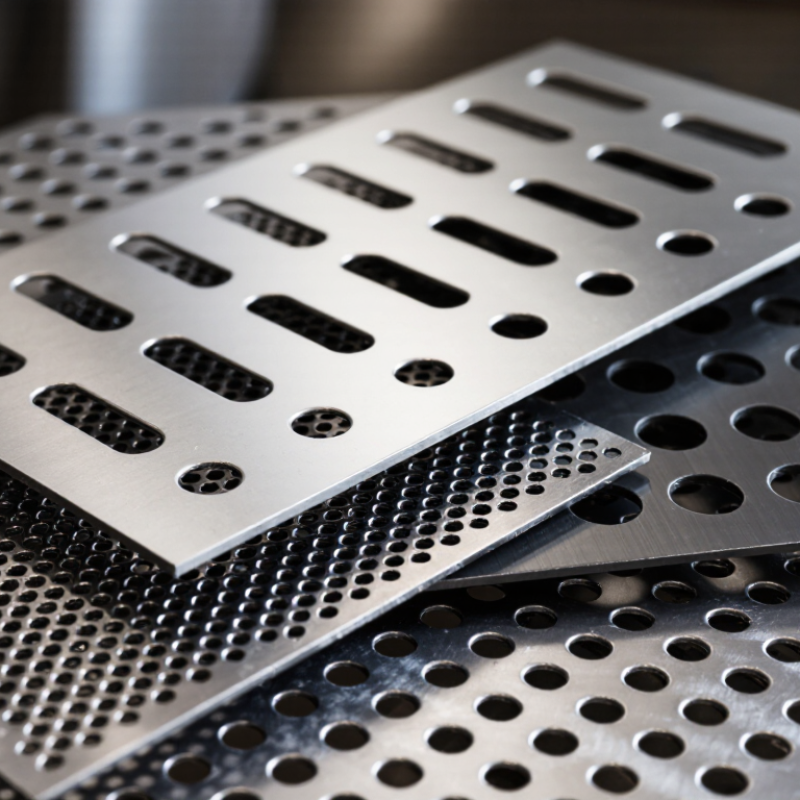
Choosing a perforated sheet starts with the hole shape. Round holes suit general screening, airflow, and lightweight panels. Square holes provide more open area and a cleaner visual pattern. Slotted holes work well when drainage, directional airflow, or elongated openings matter.
I have found that appearance often influences decisions more than expected.
Hole size controls performance. Smaller holes improve filtration and reduce visibility, but they can restrict airflow. Larger holes increase ventilation and reduce weight, yet they may weaken the sheet.
Measure the smallest object that must stay behind the panel. Allow a practical margin. This step is easy to underestimate.
Pattern affects strength, appearance, and material use. Staggered patterns usually provide greater open area than straight patterns. Straight patterns may simplify alignment during installation. Check the open area percentage carefully.
A high percentage can improve airflow, but it may reduce rigidity. For load-bearing panels, review thickness, material type, support spacing, and edge distance together. Do not select holes in isolation.
A sample panel can reveal glare, noise, sharp edges, and cleaning difficulties before full production. It may also expose a poor assumption. That is useful.
Evaluate Sheet Thickness, Strength, Finish, and Fabrication Options
How to Choose the Right Perforated Sheet for Your Needs?
Choosing perforated sheet starts with load, airflow, and environment. Thickness alone does not define strength. Hole diameter, pitch, edge distance, and remaining ligament can control bending and tearing. For a round, staggered pattern, open area is approximately 90.7(d²/c²) percent. That quick calculation helps compare ventilation without guessing. ASTM E8/E8M tensile testing supports grade comparisons, but it does not replace panel-level testing. The World Steel Association reported 1,888 million tonnes of crude steel production in 2023. That scale makes documented grade, heat number, and certificate checks worth the effort. A practical warning: a thick panel may still deform around a large opening.
Finish selection should follow exposure, cleaning method, and expected service life. For humid or chemical areas, specify corrosion-resistant alloy or a qualified coating system. ASTM B117 salt-spray results can compare coatings, yet they do not perfectly predict outdoor corrosion. That limitation matters. Ask for coating thickness, adhesion data, and repair instructions before fabrication. Laser cutting, punching, shearing, and bending create different edge conditions. Confirm burr limits, hole tolerance, flatness, and minimum web width with the fabricator. The World Steel Association report is broad, not perforation-specific. I would not treat it as a design guarantee. Use a small sample when appearance, drainage, or airflow matters.
How to Choose the Right Perforated Sheet for Your Needs? - Evaluate Sheet Thickness, Strength, Finish, and Fabrication Options
| Evaluation Dimension | Common Option or Range | Typical Performance | Recommended Applications | Selection Notes |
|---|---|---|---|---|
| Material | Mild steel, stainless steel, aluminum | Mild steel provides economical structural strength; stainless steel offers corrosion resistance; aluminum provides low weight. | General fabrication, food-processing areas, outdoor equipment, ventilation panels, machine guards | Choose the material according to corrosion exposure, weight limits, hygiene requirements, and forming needs. |
| Sheet Thickness | Approximately 0.5–3.0 mm for light-duty panels; 3.0–6.0 mm for heavier-duty components | Thicker sheets generally improve rigidity, impact resistance, thread engagement, and load capacity. | Thin panels for screens and covers; medium thickness for guards and enclosures; heavy thickness for platforms and structural components | The actual load capacity also depends on span, support spacing, hole size, hole arrangement, and edge distance. |
| Hole Shape | Round, square, slotted, rectangular, or hexagonal | Round holes provide balanced strength and airflow; slots support directional screening; square and hexagonal holes can provide high open area. | Air grilles, acoustic panels, filtration supports, safety guards, decorative screens | Select the shape based on airflow direction, particle retention, visual appearance, and required stiffness. |
| Hole Diameter or Width | Common round-hole sizes: approximately 1–20 mm; larger openings are available for specialized uses | Smaller openings improve screening and reduce the passage of larger particles; larger openings increase airflow and reduce weight. | Fine screening, ventilation, sound control, equipment protection | Avoid selecting a hole size solely by open area; minimum bridge width and sheet strength must also be checked. |
| Open Area | Approximately 20%–60% for many standard patterns | Higher open area generally improves airflow, light transmission, and drainage but reduces the solid cross-section. | Ventilation covers, acoustic panels, drying screens, architectural façades | For round holes in a 60° staggered pattern, open area can be estimated as: π × d² ÷ (2.598 × p²) × 100%, where d is hole diameter and p is pitch. |
| Hole Pattern | 60° staggered, straight row, or custom layout | Staggered patterns can provide efficient open area; straight-row patterns simplify alignment and visual layout. | General ventilation, decorative panels, screening, machine guarding | Specify pitch, margins, hole orientation, and blank areas around mounting points. |
| Strength and Rigidity | Light-duty, medium-duty, or heavy-duty design | Strength is influenced by material yield strength, thickness, unsupported span, hole geometry, and remaining ligaments. | Walkways, guards, access panels, equipment frames, structural screens | Use stiffening ribs, folded edges, or support frames when a large perforated panel may flex or vibrate. |
| Surface Finish | Mill finish, hot-dip galvanized, powder coated, painted, or brushed | Coatings can improve corrosion resistance, appearance, cleanability, and resistance to handling wear. | Indoor panels, exterior façades, industrial guards, hygienic environments | For cut, bent, or welded parts, confirm whether edges and heat-affected areas require additional protection. |
| Corrosion Resistance | Low, moderate, or high resistance depending on material and finish | Stainless steel and aluminum resist many corrosive environments; coated or galvanized steel can improve the service life of carbon steel. | Outdoor equipment, marine-adjacent areas, washdown zones, chemical-processing surroundings | Evaluate humidity, salt exposure, chemicals, temperature, and contact with dissimilar metals before final selection. |
| Fabrication Options | Cutting, bending, punching, laser processing, welding, rolling, and edge forming | Fabrication can convert flat sheet into frames, trays, guards, ducts, panels, and enclosures. | Custom assemblies and finished components | Provide finished dimensions, tolerances, bend locations, weld requirements, fastener holes, and edge-treatment requirements. |
| Edge Safety | Deburred, hemmed, folded, or fitted with edge trim | Edge treatment reduces sharp-edge hazards and improves handling safety. | Machine guards, public-access panels, handrails, partitions | Specify deburring or formed edges when the sheet will be handled frequently or installed in occupied areas. |
| Dimensional Requirements | Standard sheet sizes or custom cut-to-size panels | Standard sizes may reduce cost and lead time; custom sizes can minimize joints and material waste. | Architectural panels, equipment covers, filters, screens | Allow adequate solid margins around the perimeter and mounting holes to prevent tearing or local deformation. |
Verify Standards, Costs, Availability, and Supplier Quality
How to Choose the Right Perforated Sheet for Your Needs?
Selecting a perforated sheet starts with verified standards, not appearance. Confirm the material grade, thickness, hole shape, pitch, and open area. These details affect strength, airflow, weight, and installation. Ask for dimensional tolerances and test reports. Traceable documents make quality claims more reliable.
Cost needs a wider view. Compare the sheet price, tooling fees, surface treatment, packaging, freight, and expected waste. A cheaper panel may require extra cutting or replacement later. Check current availability and realistic lead times, especially for custom patterns.
In my shop-floor experience, delayed material can cost more than a modest price difference. I once focused too heavily on unit cost. That decision was not ideal.
Tips: Request a physical sample before ordering large quantities. Measure hole diameter, pitch, flatness, and edge condition. Ask how inspections are recorded and how defects are handled. A capable supplier should explain production limits clearly, provide consistent communication, and share corrective-action details when problems occur. Do not rely only on polished certificates. Visit the facility when practical, or request recent inspection images. Even then, uncertainty remains. Build a small acceptance check into your purchasing process.
Related Posts
-
Understanding the Versatility of Perforated Sheets: Applications and Benefits in Modern Design
-

What are the Benefits of Using Perforated Sheets?
-

2026 Top Trends in Perforated Metal Sheet Applications and Innovations?
-
Exploring the Versatility of Perforated Steel Sheets in Modern Architecture and Design
-
What is Perforated Aluminum Sheet and Its Applications?
-
2026 How to Choose the Right Perforated Steel Sheet for Your Project?