
Specialty Metal & Fiberglass Products
ISO 9001:2015 Certified
Cart
What Are the Top Pool Water Testers?
A clear pool can still be chemically unbalanced. That’s easy to miss. Test results help reveal changes in chlorine, pH, alkalinity, and other indicators before swimmers notice irritation or cloudy water. A reliable Pool Water Tester makes routine checks more consistent, whether you care for a backyard pool or maintain a larger one. Yet no device removes the need to follow its instructions and compare readings with the product’s recommended ranges.
This guide looks at the top pool water testers by considering accuracy, ease of use, test speed, durability, and ongoing costs. Options may include digital meters, color-matching kits, and test strips, each suited to different habits and budgets. A digital display can feel precise, but calibration and probe care matter. Strips are quick, though lighting and color judgment can affect interpretation. Small details count. Wet fingers, an old reagent bottle, or a test taken near a return jet may distort a reading. We will weigh these practical trade-offs rather than treat one format as best for every pool. A careful check takes minutes. It can reduce guesswork, but it cannot replace proper maintenance or professional advice when results remain unusual. Some comparisons are imperfect; product models and testing conditions change. Use the recommendations as a starting point, then verify readings and instructions for your specific equipment.
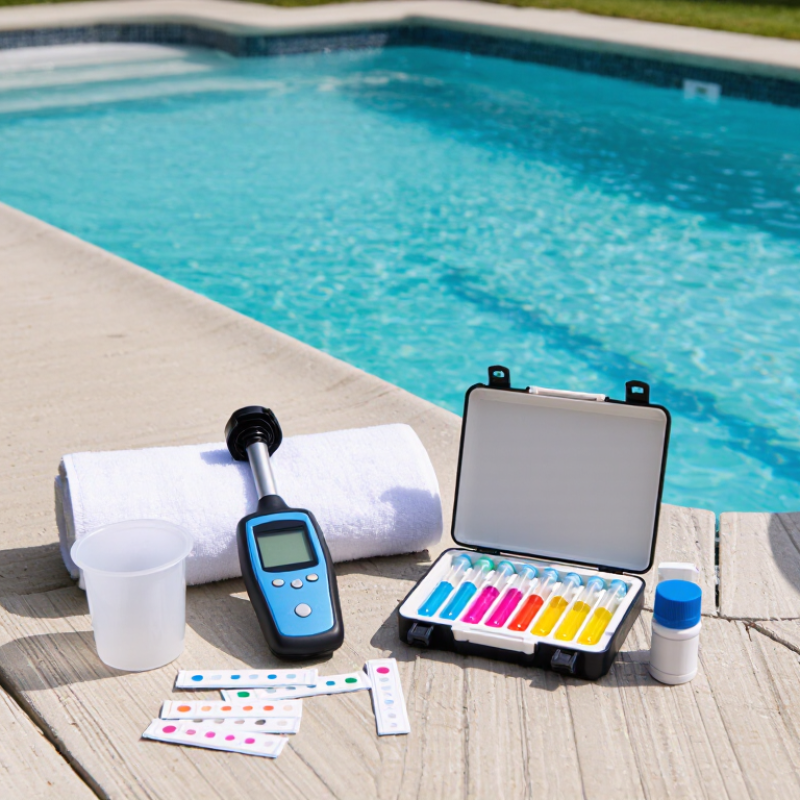
What Pool Water Testers Measure
What Are the Top Pool Water Testers?
What Pool Water Testers Measure
Pool water testers check more than chlorine. Most measure free chlorine, which sanitizes the water, and pH, which affects comfort and chlorine performance. Some also measure total alkalinity, calcium hardness, and cyanuric acid. These readings help identify conditions linked to corrosion, scale, or unstable sanitizer levels. Small differences matter.
The CDC’s 2023 Model Aquatic Health Code sets a pool pH range of 7.0–7.8. It recommends at least 1 ppm free chlorine in pools without cyanuric acid, and at least 2 ppm when it is used. Those figures offer a useful reference, but local operating guidance and pool conditions still matter. A tester that checks only pH and chlorine will not flag every water-balance issue.
Test strips give quick readings, while liquid kits can offer more measured color comparisons; digital instruments may report values directly. None removes the need to follow its instructions. I sometimes trust a quick strip too much: wet fingers, fading strips, and poor lighting can blur the color match. Check the expiration date, test near the same time of day, and record results. Consistent readings make trends easier to spot.
What Are the Top Pool Water Testers? - What Pool Water Testers Measure
| Tester type | What it can measure | How the result is obtained | Best suited for | Important limitations |
|---|---|---|---|---|
| Multi-parameter test strips | Depending on the strip: free chlorine, total chlorine, pH, total alkalinity, calcium hardness, and cyanuric acid. | A treated pad changes color; the color is compared with the supplied chart. | Quick routine checks and a broad overview of pool chemistry. | Readings are approximate and depend on correct timing, lighting, storage, and careful color matching. Not every strip measures every listed parameter. |
| Liquid reagent color-comparison kit | Commonly free and total chlorine or bromine, plus pH; some kits also test alkalinity, hardness, or cyanuric acid. | Pool water is mixed with specified liquid reagents and compared with a color scale. | Regular home testing when more control over the test procedure is desired. | Requires accurate sample and reagent amounts. Reagents have a shelf life, and color matching can be subjective. |
| Digital photometer or colorimeter | Parameters supported by the device and its reagents, often free or total chlorine, pH, alkalinity, hardness, or cyanuric acid. | The instrument measures the color intensity produced by a reagent and displays a numerical result. | Users who want numeric readings and more consistent color interpretation. | Each test is limited to the device’s supported methods. Reagents, clean sample cells, and correct calibration or blanking may be required. |
| Electronic pH meter | pH, reported on the pH scale (0–14). | An electrode measures the sample’s electrical response and converts it to a pH reading. | Checking pH when a numerical reading is preferred over color comparison. | It does not measure chlorine or other pool chemicals. The probe needs proper storage, cleaning, and periodic calibration. |
| Salt or conductivity meter | Electrical conductivity, often converted to an estimated salinity or salt concentration, usually shown in ppm or g/L. | Electrodes measure how readily the water conducts electricity. | Checking salt concentration in pools that use saltwater chlorination. | It does not measure free chlorine. Other dissolved ions can affect conductivity, and readings should be interpreted using the pool system’s guidance. |
| TDS meter | Total dissolved solids (TDS), typically displayed in ppm or mg/L and commonly estimated from conductivity. | A conductivity measurement is converted to an approximate dissolved-solids value. | Tracking broad changes in dissolved material over time. | It does not identify which substances are dissolved and cannot replace tests for sanitizer, pH, alkalinity, or hardness. |
Measurement availability and detection ranges vary by test method. Follow the tester’s instructions and use a separate test for any parameter the device does not measure.