Cart
What Are the Top Perforated Stainless Steel Types in 2026?
Perforated stainless steel turns solid sheet into a working surface: round holes can aid drainage, while narrow slots guide airflow or screen particles. In 2026, choosing a type means balancing hole shape, open area, thickness, and alloy—not simply selecting the most attractive pattern. The World Stainless Association reported global stainless-steel crude production of 62.6 million tonnes in 2024, an indicator of the material’s broad industrial footprint, not a forecast for perforated-sheet demand. Its production figures provide useful context, but they cannot tell buyers which pattern will perform best in a specific application.
Common options include round-hole, square-hole, slotted, and decorative patterns, made in grades such as 304 and 316. Round holes are a familiar choice for guards and screens; slots may suit drainage or directional airflow. Small differences matter. A tighter pitch can change the sheet’s strength and flow, while coastal exposure may call for more corrosion-resistant material. ASTM International’s A240/A240M specification helps define stainless plate, sheet, and strip grades, but it does not replace application-specific testing. That distinction is easy to miss.
This guide compares leading perforated stainless steel types by pattern, practical use, and selection trade-offs. It also flags where published data is limited: performance depends on alloy, thickness, fabrication, and operating conditions. No universal winner. Before ordering, confirm dimensions, tolerances, finish, and service environment with the supplier, then request a sample when fit or appearance is critical. One caution: a visually open pattern may still restrict flow once installed.
Define Perforated Stainless Sheet Under ASTM A240
Perforated stainless sheet is stainless sheet with holes formed by punching or another perforating process. Under ASTM A240/A240M, the material falls within specifications for chromium and chromium-nickel stainless steel plate, sheet, and strip. The standard addresses requirements such as grade chemistry and mechanical properties. It does not specify hole shape, spacing, or open area. That distinction matters. A compliant base sheet does not automatically mean the finished perforated panel meets every dimensional requirement.
For material context, World Stainless reported that global stainless steel production rose 7.0% in 2024 compared with 2023. That industry figure signals broad material use, not a recommendation for any particular perforation. When reviewing a quotation, check the stated ASTM grade, sheet thickness, and applicable test documentation. Also confirm whether tolerances refer to the unperforated sheet or the finished product.
Application details guide the choice. Chloride exposure, operating temperature, and cleaning chemicals can affect grade suitability. Hole diameter and spacing matter too: narrow metal bridges between holes may reduce stiffness, while small openings can collect debris. Burrs can catch cloth or gloves. Inspect a physical sample when finish and flatness matter; drawings alone may miss edge details. One caution: open area is not a strength rating, and the standard’s grade designation cannot replace a finished-part assessment.
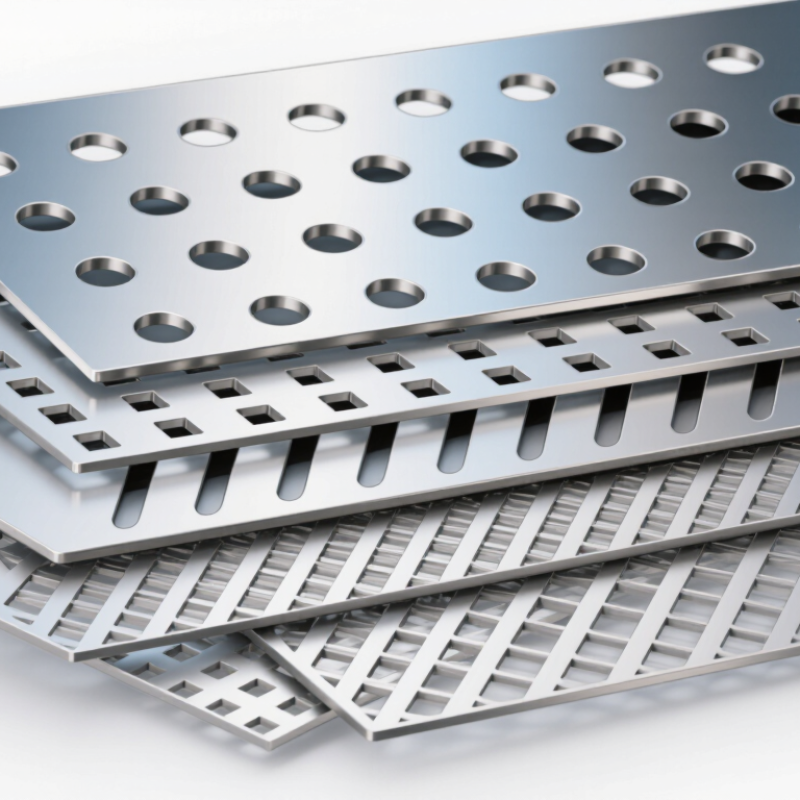
Compare Round, Slotted, Square, and Hexagonal Hole Patterns
What Are the Top Perforated Stainless Steel Types in 2026?
Compare Round, Slotted, Square, and Hexagonal Hole Patterns
Round holes remain a practical choice for general screening, ventilation, and guards. Their smooth shape distributes material evenly, and standard sizes are often easy to source.
Slotted holes allow airflow or drainage in a chosen direction. On a machine cover, for example, vertical slots can help water run downward, but may offer less stiffness across the slot direction. Check the sheet’s thickness and support spacing before choosing.
Square patterns can provide a clean, structured appearance and useful open area. However, sharp corners may concentrate stress, and narrow webs between holes can bend under handling.
Hexagonal patterns often fit many openings into a panel, which can increase open area while retaining a connected web. Results depend on hole size, pitch, sheet gauge, and edge margins—not the pattern alone. There is no universal winner; sample panels can reveal details a drawing misses.
Tips: Compare open area, flow direction, stiffness, and cleaning needs. Inspect cut edges and burrs, especially where hands or products may contact the sheet. Specify stainless grade and finish for the actual environment. A pattern that looks right on screen may feel too flexible in a full-size panel.
Calculate 60° Staggered Round-Hole Open Area: 90.7 × (Hole ÷ Pitch)²%
Round holes remain a practical choice for screens, guards, and airflow panels because their open area is easy to estimate. Slotted patterns suit directional drainage; square holes can provide a different balance between passage and support. Decorative patterns add visual options, but their usable open area depends on the layout. Small holes matter. Grade selection matters too: 304 is common for general service, while 316 is often considered where chloride exposure is a concern. Confirm the required grade and finish against the project specification and applicable material documentation. World Stainless’ Stainless Steel in Figures 2024 reports global stainless crude-steel production of 58.4 million tonnes in 2023, a reminder of the material’s broad industrial use—not a guarantee that any particular sheet suits your environment.
For circular holes on a 60° staggered pattern, estimate open area as 90.7 × (hole diameter ÷ pitch)²%. Pitch is the center-to-center distance between neighboring holes. With a 3 mm hole and 5 mm pitch, the estimate is 90.7 × (3 ÷ 5)², or about 32.7%. That is a useful starting point. It assumes a regular pattern and does not account for edge margins, tolerances, or blocked holes. In practice, burrs and coating buildup can also affect flow. I would check a sample panel when airflow or drainage is critical; the calculation alone can look more certain than the finished sheet really is.
Choose 304 (18–20% Cr) or 316 (2–3% Mo) for Corrosion Resistance
For many perforated stainless steel panels, the choice comes down to 304 or 316. Type 304 typically contains 18–20% chromium and about 8–10.5% nickel. Chromium helps form a protective oxide layer on the surface. In dry indoor spaces, kitchens, and general equipment enclosures, 304 often provides dependable corrosion resistance at a reasonable cost.
Perforation exposes many hole edges, so clean punching, deburring, and finishing matter alongside the alloy grade. Type 316 typically contains 2–3% molybdenum, which improves resistance to chlorides found in salt spray and some cleaning solutions. That makes it a sensible option for coastal equipment or frequent washdown. It is not corrosion-proof, though. Deposits, crevices, and poor maintenance can still cause problems. A practical specification should describe the environment, not just name a grade. I would not choose 316 automatically; it may add cost without solving the actual exposure. A small sample helps. Check the finish and edges after exposure to the expected conditions, and confirm the supplier’s material documentation before ordering.
Match Sheet Thickness, Hole Size, and Open Area to Service Needs
What Are the Top Perforated Stainless Steel Types in 2026?
Round-hole sheets suit screening, airflow, and drainage, while slotted patterns can guide elongated particles or improve directional flow. Square holes offer a different balance of passage and support. The right choice depends on what the sheet must do, not just how it looks. Small holes matter.
Thickness affects stiffness, weight, and how well a panel resists dents or vibration. A thin sheet may work for a light filter, but a machine guard or heavily handled panel may need more support. Hole size also matters: smaller openings can retain finer particles, yet may clog more easily and reduce flow. There is no universal thickness-to-hole ratio; supports, material grade, and forming method can change the result.
Open area is the portion of the sheet left unobstructed by metal. More open area can improve airflow or drainage, but it usually leaves less material to carry loads. Check the pattern, hole spacing, and edge margins together. For a real service condition, compare supplier drawings with the expected pressure, particle size, and cleaning method. It is tempting to specify the highest open area. That can be a mistake. A small sample test may reveal issues that a neat specification misses.
Related Posts
-
China Top Perforated Steel Sheet Supplier for Global Buyers
-
Top 10 Benefits of Using Stainless Steel Perforated Sheet in Your Projects
-
2025 Guide: How to Choose the Right Wire Mesh Screen for Your Project
-
Why Choose Expanded Metal Sheet for Your Next Project?
-
2026 Best Metal Mesh Sheet for Global Buyers Guide?
-
Top 10 Types of Metal Mesh Sheet for Global Buyers?